Pages

Tuesday, March 4, 2014

I/D2: Unit O - Derive the SRTs

INQUIRY ACTIVITY SUMMARY
As seen in the square, you have to cut it diagonally because that is how you can get two triangles. If they are equally bisected, they will form two 45-45-90 triangles. You get the hypotenuse by using the Pythagorean theorem (a^2+b^2=c^2). We are told that the side lengths of the square are 1. That means the side lengths of a and b of the triangle are 1 as well. You take (1)^2+(1)^2=c^2. That will give you c=radical 2; this is your hypotenuse. "n" means the variable used to find your sides. Since in a 45-45-90 degree triangle the sides corresponding to the 45 degree angles are the same, we can label them with "n." 


In the 30-60-90 triangle, I got it by bisecting an equilateral triangle down the center. Since the sides of the equilateral are equal to 1, I knew the hypotenuse was 1. The base is 1/2 since we cut the triangle in half. I then used Pythagorean theorem to find the height which gave me a=radical 3 over 2. This translates to the normal pattern because side a is n equal to n. The hypotenuse is double that. Here we see that side a (1/2) was multiplied by 2. (2)(1/2)=1; that is our hypotenuse. To find the height, we are most familiar with n radical 3. Our n in 1/2. We multiply that by radical 3. That gives us radical 3 over 2 as our height. We use n because that's the variable we are most familiar with when we first learned about triangles in geometry. In this problem the b is n, the hypotenuse is 2n and the height is n radical 3.


INQUIRY ACTIVITY REFLECTION

Something I never noticed before about special right triangles is
that they can be made from squares and triangles. After learning the unit circle, I thought special triangles were only used in that.
Being able to derive these patterns myself aids in my learning because
I now better understand my last unit as well as understand where my values come from. Before I just had to memorize the values of each side without knowing how I got them.

Saturday, February 22, 2014

I/D1: Unit N - How do SRT and UC relate?

INQUIRY ACTIVITY SUMMARY
Describe the 30* triangle
Click HERE.
Describe the 45* triangle
Click HERE.
Describe the 60* triangle
Click HERE.


1. The coolest thing I learned from this activity was...
how to find these points and coordinates mathematically instead of memorizing it by heart.
2. This activity will help me in this unit because...
I can now better understand how to label my triangles and my unit circle. It also showed me patterns I didn't notice before.
3. Something I never realized before about special right triangles and the unit circle is…
that they actually relate to each other! I was told that in past math courses, but I didn't quite grasp what it meant.

Monday, February 10, 2014

RWA#1: Unit M Concept 5: Graphing Ellipses Given an Equation and Identifying All Parts

1. The mathematical definition of an ellipse is "the set of all points such that the sum of the distance from two points is a constant." (http://www.mhhe.com/math/precalc/barnettca2/student/olc/graphics/barnett01caaga_s/ch07/downloads/pc/ch07section2.pdf)


2. An ellipse is algebraically shown with the equation written in standard form: (x-h)^2/a^2+(y-k)^2/b^2=1 or (x-h)^2/b^2+(y-k)^2/a^2.  The center is always (h,k).  "a" is always bigger than "b."  Remember that a and b are squared in the equation, so you have to take the square root of them when writing them out on the template.

It can be graphically shown as a visual on a graph.  An ellipse typically looks like a squished circle from its sides or top and bottom.

Here is how you can identify key parts on the graph:
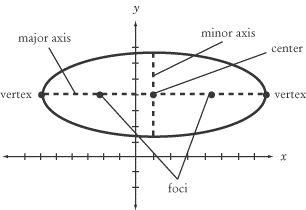
If a is under x in the equation (the first one listed above), the graph will be fat. The major axis length is 2a (Mrs. Kirch shows this with a solid line); the minor axis length is 2b (she shows this with a dotted line). In this kind of equation, the major axis will run horizontally.
To find vertices: Count "a" units from the center going left and right; plot these points. To find co-vertices: Count "b" units from the center going up and down; plot these points.

If a is under y in the equation (the second one listed above), the graph will be skinny. The major axis length is 2a; the minor axis length is 2b.  In this kind of equation, the major axis will run vertically.  To find vertices: Count "a" units from the center going up and down; plot these points. To find co-vertices: Count "b" units from the center going left and right; plot these points.

The foci effects the shape because the further away it is to the vertices, the more it will have to "focus" on that point.  When the foci increases, the eccentricity does, too. To find your foci, the major axis value will be the number that does NOT change in the foci points. (ex. If the major axis is y=-2, your two foci will be (#, -2).) To find the other number, (ex. It would be x.), you take the value from your minor axis and add AND subtract it to/from your c value.  In order to find c, you use the equation a^2+b^2=c^2.
Your eccentricity is greater than 0 but less than 1 and can be found with "c/a.

Do you want to see a problem worked out? Watch this video example.


3. A real world application of an ellipse would be when you tilt your glass cup with a drink to take a sip out of it. The drink in your cup will form an ellipse around the cup's interior.  Let's take for example a glass of milk.  When the milk is in the cup and set on the table, you may notice the top of the milk is shaped as a circle. Once you begin to tilt the cup and bring it to your mouth for a sip, the shape at the top of the milk is no longer a circle.

The ellipse is formed because the eccentricity has increased. It will continue to increase as you tilt the cup. The center of the ellipse moves further from the center of the cup the more you title your cup.  I would associate this example as a skinny ellipse represented with the equatio(x-h)^2/b^2+(y-k)^2/a^2 because the cup's ellipse would be facing me. The point closest to my lip and furthest to me would be the vertices.  The left and right side of the cup would be my co-vertices.

4. Works Cited
Ellipse Image pasted from: http://img.sparknotes.com/content/testprep/bookimgs/sat2/math2c/0006/ellipse.gif
Tilted Milk Cup Image pasted from: http://lisamasson.photoshelter.com/image/I0000RM3hrmrL0Po
Ellipse Video Example video from: http://www.youtube.com/watch?v=wTGA9D4Y0qk

Sunday, December 8, 2013

SP#6: Unit K Concept 10 - Find Sums of Infinite Geometric Series


Make sure you pay close attention to what numbers to plug into each part of the formula. I tried my best to color code it, so it is easier to follow along. Also, don't forget about that whole number! Adding it to the last part of your problem is what gives you your final answer.

Sunday, December 1, 2013

Fibonacci Beauty Ratio (Extra Credit)

Stephanie V. 
Foot to Navel: 99 cm   Navel to top of Head: 63 cm   Ratio: 99/63=1.571 cm 
Navel to chin: 45 cm                      chin to top of head: 23 cm       Ratio:45/23=1.957 cm 
Knee to navel: 53 cm                      Foot to knee: 52 cm                Ratio: 53/52=1.019 cm 

Average: 1.516 cm

Helena C. 
Foot to Navel: 102 cm   Navel to top of Head: 66 cm   Ratio: 102/66=1.545 cm 
Navel to chin: 45 cm                      chin to top of head: 22 cm       Ratio:45/22=2.045 cm 
Knee to navel: 56 cm                      Foot to knee: 45 cm                Ratio: 56/45=1.244 cm 

Average: 1.611 cm


Joshua N. 
Foot to Navel: 102 cm   Navel to top of Head: 67 cm   Ratio: 102/67.=1.522 cm 
Navel to chin: 45 cm                      chin to top of head: 23 cm       Ratio: 45/23= 1.957 cm 
Knee to navel: 61 cm                      Foot to knee: 47 cm                Ratio: 61/47=1.300 cm 

Average: 1.629 cm

Rodolfo R. 
Foot to Navel: 100 cm   Navel to top of Head: 64 cm   Ratio: 100/64 =1.563 cm 
Navel to chin: 46 cm                      chin to top of head: 25 cm       Ratio:46/25=  1.840 cm 
Knee to navel: 54 cm                      Foot to knee: 46 cm                Ratio: 54/46=1.174 cm 

Average: 1.526 cm

Christine N. 
Foot to Navel: 96 cm   Navel to top of Head: 60 cm   Ratio: 96/60= 1.6 cm 
Navel to chin: 42 cm                      chin to top of head: 22 cm       Ratio: 42/22= 1.909 cm 
Knee to navel: 51 cm                      Foot to knee: 45 cm                Ratio: 51/45= 1.133 cm 

Average: 1.547 cm

According to Fibonacci's Beauty Ratio test, Helena C was the most beautiful person I measured. Her measurements were but 0.007 away from the Golden Ratio. Her ratios included: 1.545, 2.045, and 1.244 cm which averaged to 1.611.  I believe the Beauty Ratio is a huge disclaimer because the friends I measured besides Helena were beauty to me as well. Yes, Josh and Rodolfo, too!  However, it did show how proportional parts of our body can be, and that is what makes it stand out to others.  True beauty comes from within; some show their beauty more than others. But as I've said before in my haiku, we are all ugly.